
rTMS for Parkinson’s Disease: A Safe, Evidence-Based Option for Depression and Motor Symptoms in Older Adults
Updated: Feb 10
Parkinson’s disease affects millions worldwide, with symptoms that go far beyond tremors and stiffness. Among older adults living with PD, depression is common and often under-recognized, significantly impacting quality of life, daily functioning, and overall wellbeing. Research estimates that up to half of people with Parkinson’s experience clinically significant depressive symptoms, not simply as a reaction to disability, but as an intrinsic feature of the disease’s neurobiology. This includes changes in dopaminergic, serotonergic, and frontal-striatal networks, which contribute to mood dysregulation alongside motor impairment.
At Manaha Clinic | Mind & Neuro Centre, we specialise in holistic, evidence-based care for Parkinson’s disease, including repetitive Transcranial Magnetic Stimulation (rTMS), a non-invasive neuromodulation therapy that is gaining strong support in clinical research for both motor and non-motor symptoms of PD.
What Is rTMS?
Repetitive Transcranial Magnetic Stimulation (rTMS) uses focused magnetic pulses to modulate neuronal activity in targeted brain regions. It is non-invasive, well-tolerated, and does not require anaesthesia or systemic medications. rTMS is already widely used globally for treatment-resistant depression and shows promising benefits in Parkinson’s disease when delivered under clinical supervision.
Evidence Base: rTMS for Motor and Depressive Symptoms in Parkinson’s
Scientific evidence supports the use of rTMS in PD for both motor symptoms and mood:
Motor symptoms: Meta-analyses show that rTMS leads to significant improvements in motor function (measured by UPDRS-III scores), especially with high-frequency stimulation over motor cortex regions. Reference below - https://pubmed.ncbi.nlm.nih.gov/41180704/
Depression and non-motor symptoms: rTMS targeting the dorsolateral prefrontal cortex (DLPFC) has been shown to improve depressive symptoms in PD, with measurable effect sizes in randomized trials. Additional research indicates that rTMS may enhance walking ability and cognitive function, reflecting its broader neuromodulatory potential. Reference below -

A sham-controlled clinical study demonstrated that high-frequency bilateral rTMS over the motor cortex significantly reduced depression severity and improved quality of life in PD patients compared to controls. Ref: Neuropsychobiology on Karger
Why rTMS Matters in Parkinson’s with Depression
Depression in Parkinson’s is more than low mood — it is a neurobiological condition intricately linked to disease progression. Standard antidepressants may be less effective or poorly tolerated in older adults with Parkinson’s due to side effects or interactions with dopaminergic medication. rTMS offers a non-pharmacological, targeted approach that can complement existing therapies, improving motivation, energy, and engagement with rehabilitation.
Real Results from Manaha Clinic
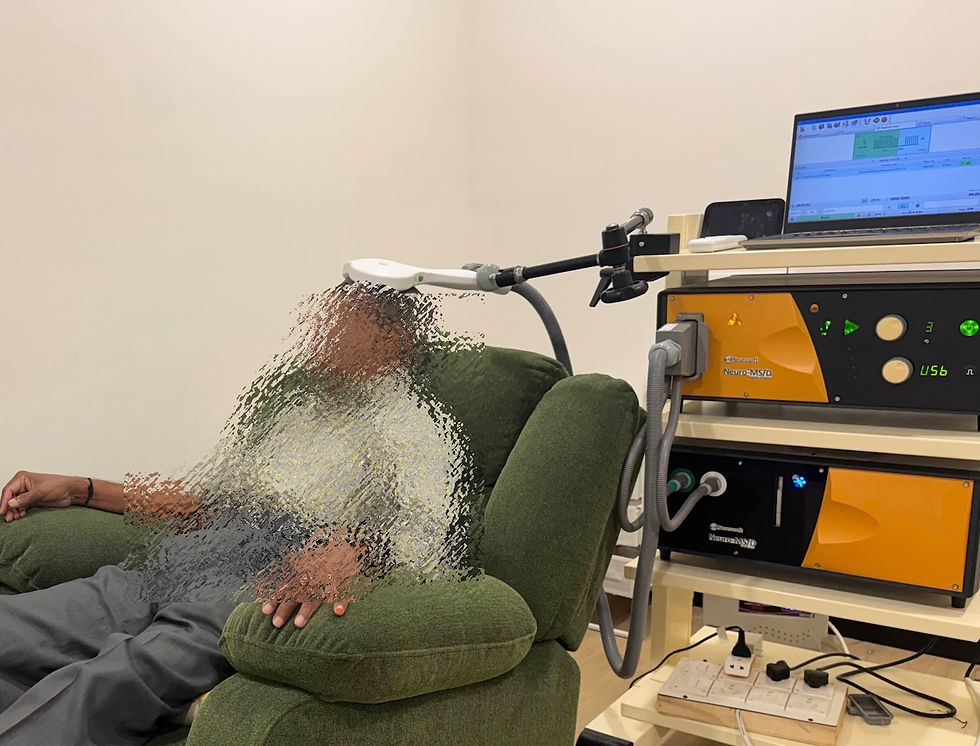
One of our patients, in his early 70s with an 8-year history of Parkinson’s, presented with persistent depressive symptoms that were affecting daily life despite optimized medication. After five sessions of rTMS administered as part of a tailored treatment plan, he experienced:
Noticeable improvement in mood and emotional engagement
Better participation in physiotherapy and activities of daily living
Increased interest in social interaction
While results can vary between individuals, this case illustrates how rTMS can augment traditional care and break the cycle of treatment-resistant depression in PD when delivered as part of a multidisciplinary program.
Who May Benefit from rTMS?
rTMS may be considered for older adults with PD who have:
Clinically significant depression or mood symptoms
Partial or inadequate response to antidepressants
Sensitivity to medication side effects
Persistent motor or gait difficulties not fully controlled by medication
Each treatment plan at Manaha Clinic begins with a comprehensive assessment by neurologists and psychiatrists, ensuring safety and individualized protocols suitable for older adults.
Safety and Tolerability
rTMS is generally well-tolerated in elderly populations. Common side effects are mild and transient, such as scalp discomfort or mild headache. It does not cause systemic side effects and does not require sedation, making it particularly suitable for older patients with complex medication regimens.
Book a Consultation
If you or a loved one is living with Parkinson’s disease and struggling with mood changes, reduced motivation, or motor challenges, rTMS could be a valuable adjunct to your care.
Visit our clinic page (https://www.manahaclinic.com) to learn more or book a consultation.

Comments