

From Light to Brain Circuits: Optogenetics and the 2026 Nobel Prize in Medicine
The 2026 Nobel Prize in Physiology or Medicine recognised Karl Deisseroth, Peter Hegemann and Georg Nagel for discoveries that led to optogenetics — a neuroscience technology that lets researchers control selected neurons with light. The breakthrough has changed how scientists study brain circuits, behaviour and disease.
What is optogenetics?
Optogenetics combines genetics and light. Researchers introduce genes for light-sensitive proteins, called opsins, into selected neurons. When those neurons are illuminated with the right wavelength of light, the opsins change the movement of ions across the cell membrane, allowing the neuron to be activated or inhibited with millisecond precision.
Light → opsin → ion movement → electrical change → neuron switches on or off

Why was the 2026 Nobel Prize awarded for this work?
The scientific importance is not simply that neurons can be stimulated. It is the precision of the control. Different types of neurons can sit side by side yet belong to very different circuits. Optogenetics makes it possible to manipulate a biologically defined population of neurons while leaving many neighbouring cells largely untouched.
This gave neuroscience a new way to test cause and effect. Instead of only asking which brain region becomes active during a behaviour, researchers can activate or inhibit a circuit and observe what changes.
For more detail on the laureates and the scientific journey, see Stanford University’s Nobel announcement.
How did a protein from microorganisms become a switch for neurons?
The story begins with microbial opsins. One of the best known is channelrhodopsin, a membrane protein that responds to light. When illuminated, it opens a channel that allows electrically charged ions to move across the membrane. In a neuron, that changes the membrane voltage and can trigger electrical firing.

Watch a 30-second explainer
This short video gives a quick visual introduction to the idea behind optogenetics and brain-circuit control.
From correlation to causation in neuroscience
Brain imaging is extremely useful for showing which areas are active during movement, fear, reward, memory or social behaviour. But activity alone does not prove that a particular circuit caused the behaviour. Optogenetics allows researchers to intervene directly, helping answer whether a circuit is necessary, sufficient, or merely associated with what we observe.
How does this connect with neuromodulation used today?
Optogenetics remains primarily a research technology and is not a routine treatment for depression, Parkinson’s disease or other neurological and psychiatric conditions. However, its larger scientific idea — identify a relevant brain circuit and modulate its activity — has a clear connection with modern neuromodulation.
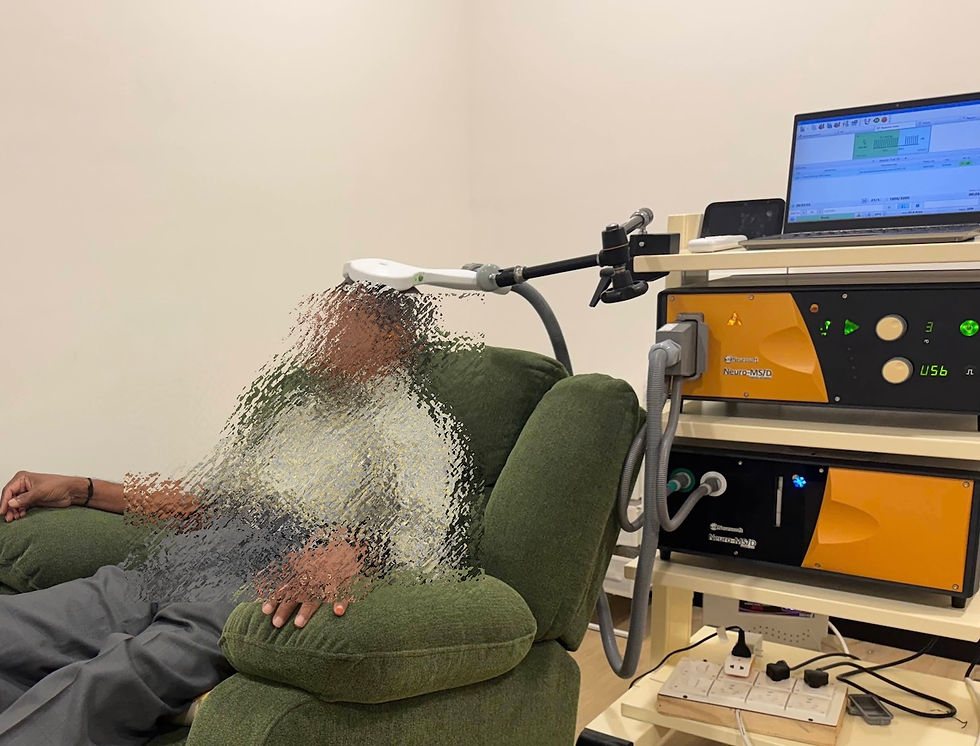
At Manaha Clinic in Hyderabad, we use repetitive transcranial magnetic stimulation, or rTMS, as part of our neuromodulation services. A magnetic coil placed over the scalp produces rapidly changing magnetic fields that induce small electrical currents in the cortex underneath.
For depression, the dorsolateral prefrontal cortex is one of the most established rTMS targets. Clinical targeting is based on recognised anatomical and physiological landmarks, and can be refined with positioning or navigation methods depending on the system being used.
What about rTMS and Parkinson’s disease?
rTMS is also being studied and used selectively in neurological conditions, including Parkinson’s-related symptoms. The evidence, targets and protocols are not the same as those used for depression, so treatment decisions need to be individualised after neurological and psychiatric assessment.
For a more detailed discussion, read our related article: rTMS for Parkinson’s disease and depression.
Optogenetics vs rTMS: what is the difference?
Optogenetics | rTMS |
Uses genetically introduced light-sensitive proteins | Uses magnetic fields applied non-invasively through the scalp |
Can target specific populations of neurons in research | Targets cortical regions and networks in clinical practice |
Research tool with very high cellular and temporal precision | Clinically available, non-invasive neuromodulation |
Where is neuroscience heading next?
The Nobel-winning work points toward a broader shift from symptom-based descriptions alone toward circuit-based neuroscience. The long-term goal is to understand which networks are dysfunctional in a condition, how they differ from one person to another, and how precisely they can be modulated.
Today, rTMS allows clinicians to influence cortical networks non-invasively. In research laboratories, optogenetics can manipulate genetically defined neurons with remarkable precision. These are very different technologies, but both illustrate a future in which brain disorders are understood increasingly through the circuits that produce symptoms.
Frequently asked questions
What is optogenetics in simple terms?
Optogenetics is a research method that makes selected neurons sensitive to light so scientists can switch their activity on or off and study what those neurons do.
Who won the 2026 Nobel Prize for the work behind optogenetics?
Karl Deisseroth, Peter Hegemann and Georg Nagel were recognised for discoveries that led to the development of optogenetics and precise light-based control of neural activity.
Is optogenetics currently used to treat depression?
No. Optogenetics is primarily a research technology. Clinical treatments such as rTMS use a different mechanism and do not require genetic modification or implanted light delivery.
How is rTMS different from optogenetics?
rTMS uses magnetic fields outside the head to influence cortical networks. Optogenetics uses light-sensitive proteins introduced into selected neurons and is currently mainly used in laboratory research.
Can rTMS be used in Parkinson’s disease?
rTMS may be considered for selected Parkinson’s-related symptoms in appropriate patients, but evidence and protocols vary by symptom and target. It should be used after specialist assessment rather than treated as a universal Parkinson’s therapy.
Congratulations to the 2026 Nobel laureates
Karl Deisseroth, Peter Hegemann and Georg Nagel have helped give neuroscience a new experimental language for understanding how brain circuits generate behaviour. Their work is also a powerful reminder that major clinical advances often begin with fundamental discoveries in basic science.
Manaha Clinic | Mind & Neuro Center, Kokapet, Hyderabad
Psychiatry • Psychology • Neurology • rTMS • Neurotechnology
Watch: optogenetics explained in about 30 seconds
For a quick visual introduction, this short video gives a simple explanation of the idea behind optogenetics.
From optogenetics to clinical neuromodulation
Optogenetics and rTMS are very different technologies, but both reflect an important direction in neuroscience: understanding brain circuits and learning how to influence them more precisely.
For readers interested in the clinical side of neuromodulation, see our related article: rTMS for Parkinson’s and Depression.
Frequently asked questions
What is optogenetics?
Optogenetics is a neuroscience research technique that combines genetics and light to activate or inhibit selected neurons with very high temporal precision.
Why was optogenetics recognised by the 2026 Nobel Prize?
The Nobel recognised discoveries that made it possible to use light-gated ion channels to control specific nerve cells, transforming the study of brain circuits and cause-and-effect relationships in neuroscience.
Is optogenetics currently used to treat patients?
Optogenetics is still primarily a research technology. It is not a routine clinical treatment in psychiatry or neurology today.
How is rTMS different from optogenetics?
rTMS uses magnetic fields applied non-invasively through the scalp to influence activity in targeted cortical regions and networks. Optogenetics uses genetically introduced light-sensitive proteins to control selected neurons in research settings.
Comments